Massachusetts Iwo Jima Memorial Vandalized Again
| Marine Corps State of war Memorial | |
|---|---|
| Us of America | |
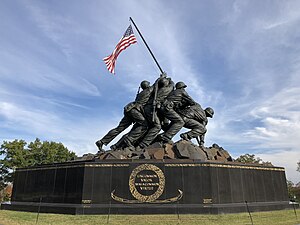 Marine Corps State of war Memorial | |
| For the Marine dead of all wars, and their comrades of other services who vicious fighting beside them. | |
| Unveiled | Nov 10, 1954 68 years ago |
| Location | 38°53′25.6″North 77°04′11.0″W / 38.890444°North 77.069722°W / 38.890444; -77.069722 Coordinates: 38°53′25.half dozen″N 77°04′11.0″W / 38.890444°North 77.069722°W / 38.890444; -77.069722 about Arlington, Virginia |
| Designed by | Felix de Weldon (sculptor) Horace W. Peaslee (architect) |
| Uncommon Valor Was A Mutual Virtue | |
The United States Marine Corps War Memorial (Iwo Jima Memorial) is a national memorial located in Arlington County, Virginia, in the U.s.. The memorial was defended in 1954 to all Marines who have given their lives in defence force of the Usa since 1775.[1] It is located in Arlington Ridge Park inside the George Washington Memorial Parkway,[2] nigh the Ord-Weitzel Gate to Arlington National Cemetery and the Netherlands Carillon. The memorial was turned over to the National Park Service in 1955.
The war memorial was inspired by the iconic 1945 photograph of six Marines raising a U.S. flag atop Mount Suribachi during the Battle of Iwo Jima in World War II[3] taken by Associated Press combat photographer Joe Rosenthal. Upon starting time seeing the photograph, sculptor Felix de Weldon created a maquette for a sculpture based on the photo in a single weekend at Patuxent River Naval Air Station in Maryland, where he was serving in the Navy. He and architect Horace W. Peaslee designed the memorial. Their proposal was presented to Congress, but funding was non possible during the state of war. In 1947, a federal foundation was established to heighten funds for the memorial.
History [edit]


Mount Suribachi on Iwo Jima
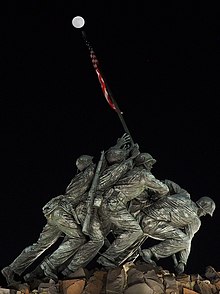
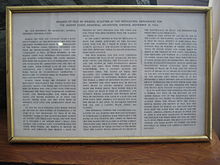
De Weldon's remarks at the 1954 dedication of the Memorial
The centerpiece of the memorial is a colossal sculpture group depicting the six Marines who raised the second and largest of two U.S. flags that were both raised atop Mount Suribachi located at the south end of Iwo Jima, on February 23, 1945. The get-go flag flown over the mountain was regarded to exist too pocket-sized to be seen by all the American troops on the other side of it where most of the fighting would take place, so it was replaced past a larger flag.
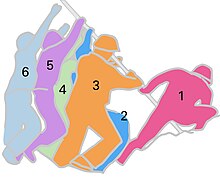
The flag-raising also was recorded by Marine Sergeant Nib Genaust, a combat motion movie cameraman. He filmed the outcome in color while standing beside Rosenthal. Genaust'southward footage established that the second flag raising was not staged. On March four, 1945, he was killed past the Japanese after inbound a cavern on Iwo Jima and his remains take never been establish. The subjects of Rosenthal'due south photograph (identification changes were fabricated in 1947, 2016, and 2019), from right to left, are as follows:[4]
- Position 1: Corporal Harlon H. Block
- Position 2: Corporal Harold P. Keller
- Position 3: Private Kickoff Class Franklin R. Sousley
- Position four: Sergeant Michael Strank
- Position 5: Private First Class Harold H. Schultz
- Position 6: Private Offset Form Ira H. Hayes
The Memorial was approved past the U.s. Congress and commission for the memorial was awarded in 1951, after information technology was canonical and accepted past the Marine Corps League who also selected De Weldon as the sculptor. De Weldon spent iii years creating a total-sized master model in plaster, with figures 32 anxiety (nine.eight thousand) tall. This was disassembled like a giant puzzle, and each piece was separately cast in bronze. Peaslee's base for the memorial is made of black diabase granite from a quarry in Lönsboda, a small town in the southernmost province of Sweden.[v] Information technology features a number of inscriptions. The Groundbreaking ceremony was held on February 19, 1954, exactly nine years afterwards the Marines landed on Iwo Jima. General Lemuel Shepherd, 20th Commandant of the Marine Corps, did the groundbreaking. Construction of the memorial began in September. The bronze pieces of the sculpture were assembled to Brooklyn, New York for casting in statuary. This took nigh 3 months to consummate. Later on that, they were reassembled into a dozen pieces and were shipped back to Arlington, Virginia in a iii truck convoy, to which was added a sixty feet (18 m) flagpole. The full cost of the memorial was $850,000, including the evolution of the site. It was paid for with donations mostly from active duty Marines and Marine Reservists. Other donors included former Marines and friends of the Marine Corps and members of the Naval Service; no public funds were used.
The memorial was defended on Wednesday, November 10, 1954, the 179th anniversary of the founding of the Marine Corps.[1] The Presiding officials included President Dwight D. Eisenhower, Vice President Richard Nixon, Secretarial assistant of Defense Charles East. Wilson, Deputy Secretary of Defence force Robert Anderson, Assistant Secretary of the Interior Orme Lewis, and General Lemuel C. Shepherd. Too the words and prayers said by 3 war machine chaplains, remarks during the dedication were given past Robert Anderson, Chairman of the Day, Colonel J.W. Moreau, U.South. Marine Corps (Retired), President, Marine Corps State of war Memorial Foundation, Orme Lewis, and General Lemuel Shepherd who presented the monument to the people of the United states of america. Following that, a U.S. flag was raised up the Memorial'due south flagpole. Felix de Weldon also spoke, and Richard Nixon gave the dedicatory address.[6] The dedication ceremony ended with the playing of taps. The Memorial was under the stewardship of the Marine Corps Memorial Foundation until the monument was dedicated.
President John F. Kennedy issued a proclamation on June 12, 1961, that a Flag of the Us should fly over the memorial 24 hours a mean solar day, which is i of the few official sites where this is required.[seven] Despite being mounted on the staff of the sculpture, which depicts an event that occurred when the U.S. flag had 48 stars, the flag used is a modernistic one (specifically, one featuring the number and arrangement of stars prescribed as of when the flag is being flown) in keeping with both the text of the proclamation and the memorial'due south dedication to all Marines who died in defense of the United states of america regardless of when their deaths occurred.
The memorial is located on a high ridge, overlooking the national majuscule. The Marine Barracks, Washington, D.C. uses the memorial as the centerpiece of its weekly Sunset Parade, featuring the Drum and Bugle Corps and the Silent Drill Platoon.
Memorial mark and inscriptions [edit]
The memorial consists of forepart and rear inscriptions, and inscribed in gold messages around the polished black granite upper base of the memorial is the appointment and location of every United States Marine Corps major activity up to the nowadays fourth dimension.
Front (west side): "Uncommon Valor Was A Mutual Virtue" – "Semper Fidelis"
Rear (due east side): "In Honour And Memory Of The Men Of The U.s. Marine Corps Who Have Given Their Lives To Their Country Since 10 Nov 1775"
Felix de Weldon's and Joe Rosenthal's names are also inscribed on the lesser left and lesser right base of the front side of the memorial. Rosenthal'south name was added in 1982.
Marker [edit]
"Dedicated To The Marine Dead Of All Wars, And Their Comrades Of Other Services Who Fell Fighting Abreast Them.
Created By Felix De Weldon, And Inspired Past The Immortal Photograph Taken By Joseph J. Rosenthal On February 23, 1945, Atop Mt. Suribachi, Iwo Jima, Volcano Islands.
Erected By The Marine Corps State of war Memorial Foundation, With Funds Provided Past Marines And Their Friends, And With The Cooperation And Support Of Many Public Officials.
Defended, November 10, 1954"
Major activity inscriptions [edit]
- Revolutionary War 1775–1783
- French Naval State of war 1798–1801
- Tripoli 1801–1805
- War of 1812 1812–1815
- Florida Indian Wars
- Mexico 1846–1848
- War Between the States 1861–1865
- Spanish State of war 1898
- Philippine Insurrection 1898–1902
- Boxer Rebellion 1900
- Nicaragua 1912
- Vera Cruz 1914
- Haiti 1915–1934
- Santo Domingo 1916–1924
- World War I 1917–1918
- Belleau Wood
- Soissons
- St. Mihiel
- Blanc Mont
- Meuse-Argonne
- Nicaragua 1926–1933
- Earth War II 1941–1945
- 1941;
- Pearl Harbor
- Wake Isle
- Bataan & Corregidor
- 1942;
- Midway
- Guadalcanal
- 1943;
- New Georgia
- Bougainville
- Tarawa
- New Britain
- 1944;
- Marshall Islands
- Marianas Islands
- Peleliu
- 1945;
- Iwo Jima
- Okinawa
- Korea 1950
- Lebanon 1958
- Vietnam 1962–1975
- Dominican Republic 1965
- Lebanon 1981–1984
- Grenada 1983
- Western farsi Gulf 1987–1991
- Panama 1988–1990
- Somalia 1992–1994
- Transitional islamic state of afghanistan 2001–2021
- Iraq 2003–
Memorial rumor and criticism [edit]
A persistent rumor has attributed the existence of a thirteenth hand from the six statues of the men depicted on the memorial, and speculation about the possible reasons for it. When informed of the rumor, de Weldon exclaimed, "13 hands. Who needed 13 easily? Twelve were plenty."[8]
In discussing the site for the United states Air Forcefulness Memorial, originally to be near de Weldon's work, J. Carter Brown, chairman of the U.s. Committee of Fine Arts in 1998, described the Marine Corps Memorial as kitsch. "It was taken from a photograph, it is past a sculptor, even though he was a fellow member of this commission at one signal, who is not going to go down as a Michelangelo in history—and even so it is very constructive, largely considering of its site," he said. Brown's remark was met with calls for his resignation from the committee, and disagreement over his categorization from the commission's staff.[9]
Refurbishment [edit]
On Apr 29, 2015, philanthropist David Rubenstein pledged over five million dollars to refurbish the memorial in accolade of his father, a Marine veteran from World War 2 who died in 2013, "and all Marines who take died in service to the United States." The $five.37 million donation, made through the National Park Foundation, supported cleaning and waxing the statue, polishing the black granite panels, regilding inscriptions, relandscaping, and making repairs to the pavement, lighting and flagpole.[x] While the Park Service performs regular routine maintenance, this was the first comprehensive refurbishment of the memorial since its dedication in 1954.[11] The work was done in three phases with completion in 2018.[12]
[edit]
When there were no authorities funds for sculpture during the state of war, the sculptor financed a concrete version of like blueprint in a 1-third size that was placed on a bundle of land in Washington, D.C. until 1947, when it was put into storage. It subsequently was restored and displayed at a museum on an shipping carrier and again, returned to storage. This minor concrete statue of the 2d U.S. flag raising at Iwo Jima in 1945 was scheduled to be auctioned in February 2013 at a New York sale defended to World War Two artifacts,[13] but it failed to receive the minimum bid required for the sale of it to begin.
Other related memorials and copies:
- The original plaster working model for the bronze and granite memorial statue currently stands in Harlingen, Texas, at the Marine Armed forces Academy, a private Marine Corps-inspired youth military academy. The academy too is the terminal resting place of Corporal Harlon Block, i of the flag raisers who was killed in activeness on Iwo Jima.
- A small model stands in the vestibule of Spruance Hall, U.Due south. Naval State of war College, Newport, Rhode Island. Information technology was presented past the sculptor, a resident of Newport.
- At that place are scaled-downwards replicas at 3 Marine bases:
- At Marine Corps Base Quantico in Virginia but outside the front gate.
- At Marine Corps Base Hawaii in Kāne'ohe Bay.
- At Marine Corps Recruit Depot Parris Island in Southward Carolina on the Peatross Parade Deck, where the replica is steel that is one-third scale and also sculpted by Weldon. For the final human action of The Crucible, the Marines' 54-60 minutes terminal training exam, Marine recruits at Parris Island hike 9 miles to the statue as the sunday rises and the flag is raised. They then are addressed on the flag raising and its meaning and are then awarded their Eagle, Globe and Anchor emblems past their drill instructors signifying them equally full-fledged Marines.[14] [15]
- A similar (though non identical) statue was erected located at Cape Coral, Florida, in 1964[xvi]
- On 18 May 1973, a statuary relief of the memorial was placed forth Cedar Point Road near St. Nicholas's Chapel at the Patuxent River Naval Air Station in Maryland.
- A version of the memorial dedicated in commemoration of the 50th anniversary of World State of war II stands in the Knoebels Amusement Resort in Elysburg, Pennsylvania.
- A similar pattern is used for the National Iwo Jima Memorial in Newington, Connecticut, which was dedicated in 1995 to the 6,821 U.South. servicemen who died in the battle.
- A copy was dedicated at Fall River's Bicentennial Park, along the banks of the Taunton River, in Massachusetts in 2005.[17]
- The tilted spire in a higher place the National Museum of the Marine Corps is a visual allusion to the original sculpture.
- A plywood cutout version is found along Highway 62 ca. 17 miles (27 km) from the centre of Twentynine Palms, California.
- Iwo Jima Sculpture and Memorial Wall at Foster Park in Young Harris, Georgia
Meet also [edit]
- Fe Mike
- National Museum of the Marine Corps
- United States Navy Memorial
References [edit]
 This article incorporates public domain material from websites or documents of the United States Marine Corps.
- ^ a b "Memorial honoring Marines defended". Reading Eagle. Pennsylvania. Associated Press. November 10, 1954. p. ane.
- ^ "Arlington Ridge Park – George Washington Memorial Parkway". National Park Service. October 31, 2017. Retrieved Apr 11, 2019.
- ^ "USMC statement on Iwo Jima flag raisers".
- ^ Robertson, Breanne, ed. (2019). Investigating Iwo: The Flag Raisings in Myth, Memory, and Esprit de Corps (PDF). Quantico, Virginia: Marine Corps History Division. pp. 243, 312. ISBN978-0-sixteen-095331-half dozen.
- ^ http://world wide web.gemeneman.se/MinSommar2005.pdf Archived August 20, 2010, at the Wayback Motorcar (in Swedish) Translation, page 3 line 28-29: The most famous war memorial in the United states of america, U.S. Marine Corps Memorial in Washington D.C., stands on a base in granite pieces from Hägghult. Hägghult is the proper name of the quarry, just outside Lönsboda.
- ^ "Marine monument seen as symbol of hopes, dreams". Spokane Daily Chronicle. Washington. Associated Press. November ten, 1954. p. 2.
- ^ "Permanent flag ordered". Kentucky New Era. Hopkinsville. Associated Press. June xiii, 1961. p. three.
- ^ Kelly, John (February 23, 2005). "One Marine's Moment". The Washington Post. Washington, D.C. p. C13. ISSN 0190-8286. Archived from the original on September 18, 2012. Retrieved July 13, 2008.
- ^ "Iwo Jima memorial called 'kitsch'". Deseret News. March eight, 1998. Retrieved March xx, 2014.
- ^ Ruane, Michael Due east. (April 29, 2015). "Billionaire David Rubenstein gives $5M to refurbish Iwo Jima sculpture". Washington Mail . Retrieved April 30, 2015.
- ^ Zongker, Brett (April 29, 2015). "Marine Corps Memorial to be restored later $5.4M donation". The Associated Press. Retrieved May one, 2015.
- ^ "U.Southward. Marine Corps War Memorial Rehabilitation – George Washington Memorial Parkway (U.Due south. National Park Service)". www.nps.gov . Retrieved January 10, 2019.
- ^ "Original Iwo Jima monument could fetch upwards to $1.8M at NYC sale". Fob News. Retrieved February viii, 2013.
- ^ Recruit Preparation – Crucible Marine Corps Recruit Depot Parris Island
- ^ Conservation of the Iwo Jima Monument Parris Island for the United states of america Marine Corps by Debbie Smith National Heart for Preservation Technology and Training
- ^ "Iwo Jima Memorial". SWFL Fine art & Community Theater. Retrieved September 17, 2015.
Many call up that it is a replica of the 60-foot-tall Iwo Jima Memorial near Arlington National Cemetery in Virginia, but it is, in fact, one of three originals that were created by a sculptor by the name of Felix de Weldon.
- ^ Daley, Lauren (November 7, 2005). "Iwo Jima monument graces Autumn River". South Declension Today. Retrieved August 31, 2017.
External links [edit]
- Official website
- Uncommon Valor A curt USMC-created film near the Iwo Jima Memorial
- Marine Armed services Academy Iwo Jima monument
- USMC War Memorial photographs at WW2DB
- Marine Corps War Memorial (Marine Barracks Washington webpage)
- Historic American Landscapes Survey (HALS) No. VA-9, "United States Marine Corps War Memorial, Marshall Drive, Arlington, Arlington Canton, VA"
- Marine Corps University History Division page on Marine Corps War Memorial
Source: https://en.wikipedia.org/wiki/Marine_Corps_War_Memorial
0 Response to "Massachusetts Iwo Jima Memorial Vandalized Again"
Postar um comentário