How to Draw a Color Wheel Circle
5 Types of Watercolor Charts - Type 3: Colour Bicycle
If you're just joining in on the series y'all tin notice web log posts on watercolor charts type ane hither and blazon two here .
We're in week 3 of this serial, and today is probably one of my favorite (and easily the about photogenic) color chart of the series: the colour bike.
The color wheel is a great starting point to enter into color mixing and color theory - and where I think I beginning discovered how magical painting was when I was immature. In that location's nada like taking two paints and seeing them mix to create a make new color right before your eyes. Information technology actually felt like magic when I was a kid. In fact, to be honest, I think I'm all the same awed by all the unlike colors I can make with merely a few colors even now...
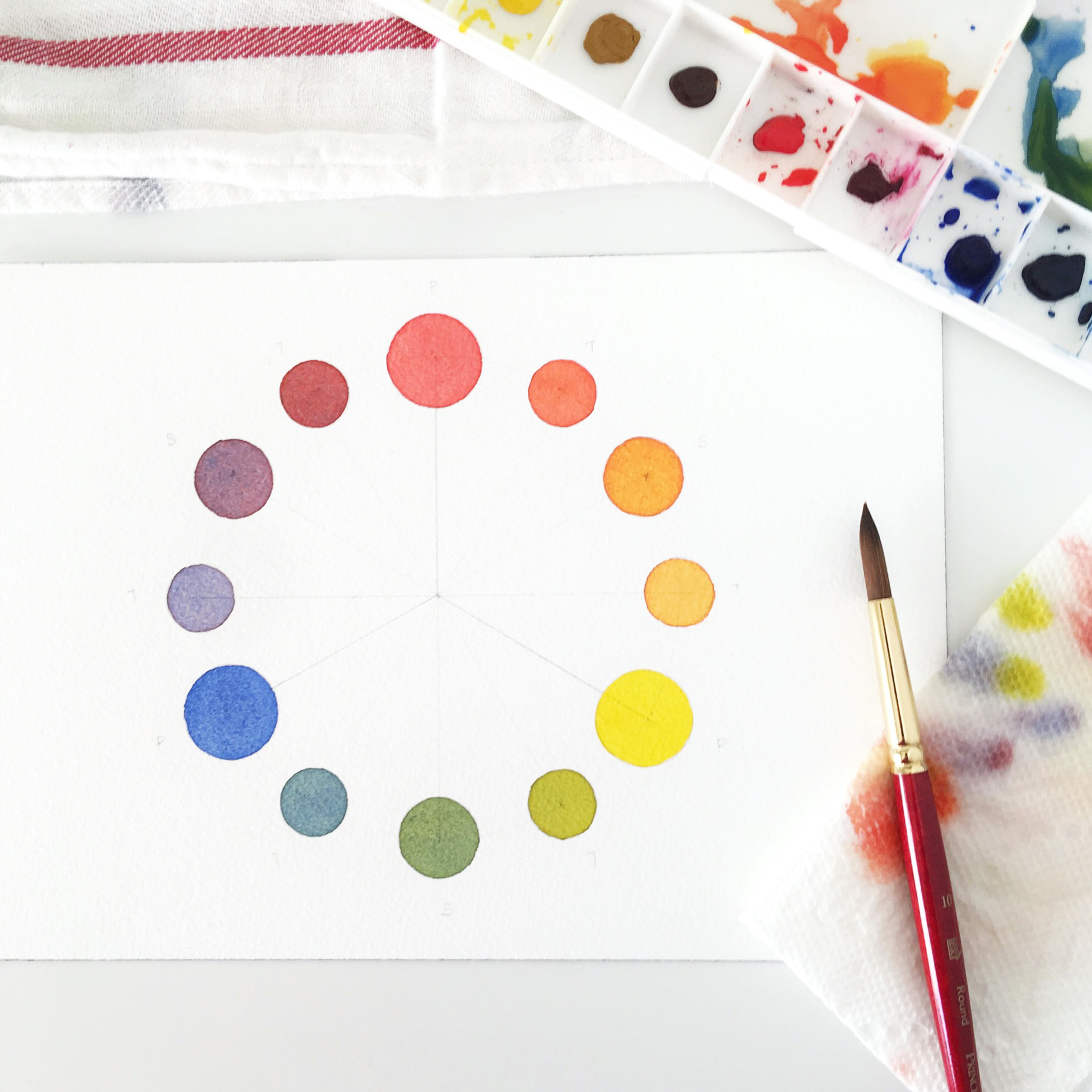
The Color Wheel
The color cycle is based on three primary colors. These 3 chief colors are mixed to create three secondary colors and then three tertiary colors.
Primary COLORS
The primary colors that make up a colour chart are: carmine, yellow, and blue. These colors cannot be made by mixing together any other colors. Merely theoretically, all colors tin can be made from these three colors - including black (just mix them in equal parts). This also means that you lot could (theoretically) paint using just these three colors without buying any other paints.
Just at that place are so many reds, yellows and dejection in watercolors, which ones do y'all choose? In this blog post, I'll testify 3 different colour wheels using unlike reds, yellows and blues.
However for now and for simplicity'due south sake, based on what I've seen, the "traditional primaries" are considered to be:
-
cadmium cherry-red
-
cadmium yellowish
-
ultramarine
And then if you're just starting, these 3 would be good primary pigments to pick up.
SECONDARY COLORS
The secondary colors - orange, green, and purple , are created by mixing two primaries:
-
Reddish + Yellowish = Orange
-
Yellow + Blue = Light-green
-
Blue + Cherry-red = Purple
With these vi colors, you now have all the colors of the rainbow.
TERTIARY COLORS
The tertiary colors are in-between colors created when mixing a master with a secondary. For example: blue + dark-green or red + imperial. Tertiaries are known to produce hues that are more "dull" than primaries or secondaries.
Now, let'south get started painting a color wheel and then take a look at a few dissimilar colour wheel examples.
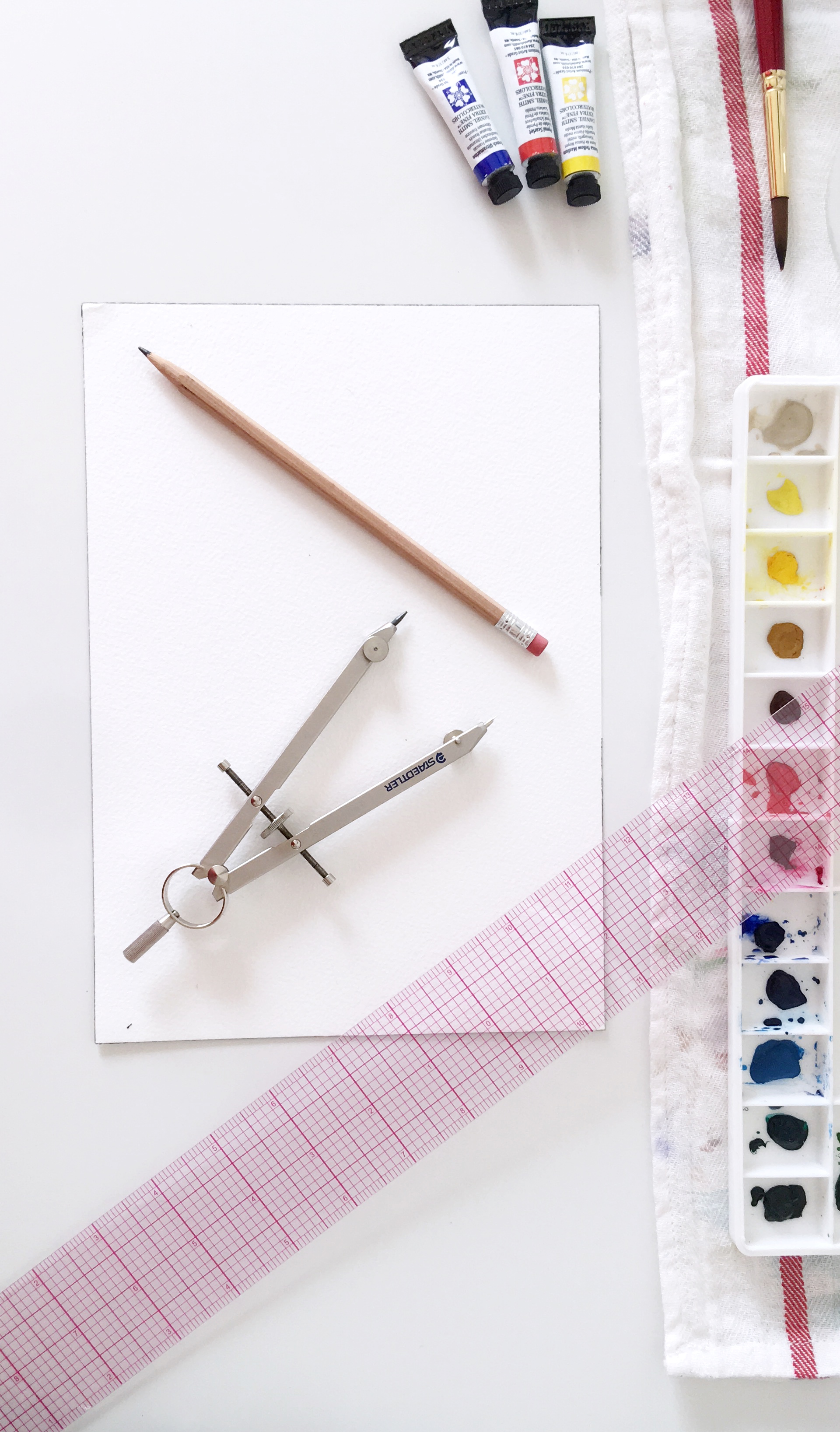
Supplies Needed:
Also the obvious paints, paper and a brush, you'll need a few other materials to make your charts. I'll list all of them below with a few recommendations:
-
watercolor paints
-
watercolor newspaper (140lb/300 gsm)
-
watercolor brush (size 6 or viii)
-
ruler (I utilize a protractor ruler)
-
pencil (2B)
-
compass (or a circle shape you lot tin can trace, like a CD)
-
circle template (optional, like)
-
water
-
paper towels
Just a note: Links to the tools I utilise are affiliate links. I purchase my own tools from these sites unless stated every bit 'similar'. If you click through and purchase, I earn a small commission with no actress cost to y'all.
How to paint a color wheel
Describe your your wheel (Optional)
I prefer cartoon out my wheel before painting, merely you lot tin can definitely gratis-manus it, if you want to swoop right in! Read on to see how I draw mine.
-
Using a compass with the radius set to approx. 2 1/2", I draw a lite circle on the page, making sure to marker the center point with a pencil. If you don't have a compass, you can utilize a CD - if you have any of those laying effectually- information technology's a practiced size for this exercise!
-
Using a ruler, draw lines to separate the circle into 12 equal slices. I draw my lines in this club:
-
Draw a vertical line - cut the circle in half top to bottom
-
Describe a horizontal line - cut the circle in one-half left to right
-
Lightly marking off two ticks spaced evenly along the circle between each of the quarters
-
Check it: If you've done this right, you should be able to see that at that place are 12 'spots' along the circumference of the circle.
-
Annotation: If you want to use a protractor, the circle should be divided into twelve 30º wedges. When I want to exist very exact, I do this - and I find that this protractor ruler is actually useful!
-
-
At each of the 12 points, you will be drawing circles with the center-signal of the circles falling along the circumference of the large circumvolve. You can free-manus or use a circle template to draw these circles.
Annotation: You can make them all the same size or you lot can make them different sizes to help differentiate between primary, secondary and tertiary colors. I adopt varying the sizes. -
If you are varying the sizes, I similar to draw the circles as follows (using clock face designations):
-
Master colors (largest circles) at 12:00, 4:00, 8:00
-
Secondary colors (medium circles) at 2:00, 6:00, 10:00
-
Tertiary colors (smallest circles) at the remaining half dozen locations
-
Paint your Bicycle
Now for the really fun function - painting and mixing colors!
This is the order in which I similar to fill out my nautical chart, although you may prefer to do it differently!
-
Paint all 3 primaries into their designated circles. I always start with Ruby-red at the pinnacle and work around clockwise to Xanthous and and so Blue. (Remember to clean your brush thoroughly when switching colors.)
-
In the same clockwise direction, mix your secondary colors. Using equal parts carmine + yellow, brand orange and paint it into the secondary colour position located between red and yellow on the cycle. I continue by finishing all the secondary colors. Notation: During this step, I effort to make sure to accept plenty paint mixed on my palette to have a "leftover puddle" to apply when I get to step iii. If you want to be _really_ prepared, make sure yous accept ii divide puddles leftover for each secondary colour - you'll run into why.
-
Working in a clockwise direction over again, I mix the tertiary colors by picking up cherry-red and mixing it into the leftover puddle of orange to create the intermediate red-orange color. Next, I take yellow and mix information technology into orangish to create the intermediate orange-yellow color. This is where having 2 puddles left over is useful - because you demand to have each secondary color on hand twice to create the tertiaries! Terminate by continuing around the circle until you lot're done!
Color Wheel Principal Colour Variations
Below you'll see examples of two unlike color wheels using two sets of primary colors: warm and absurd.
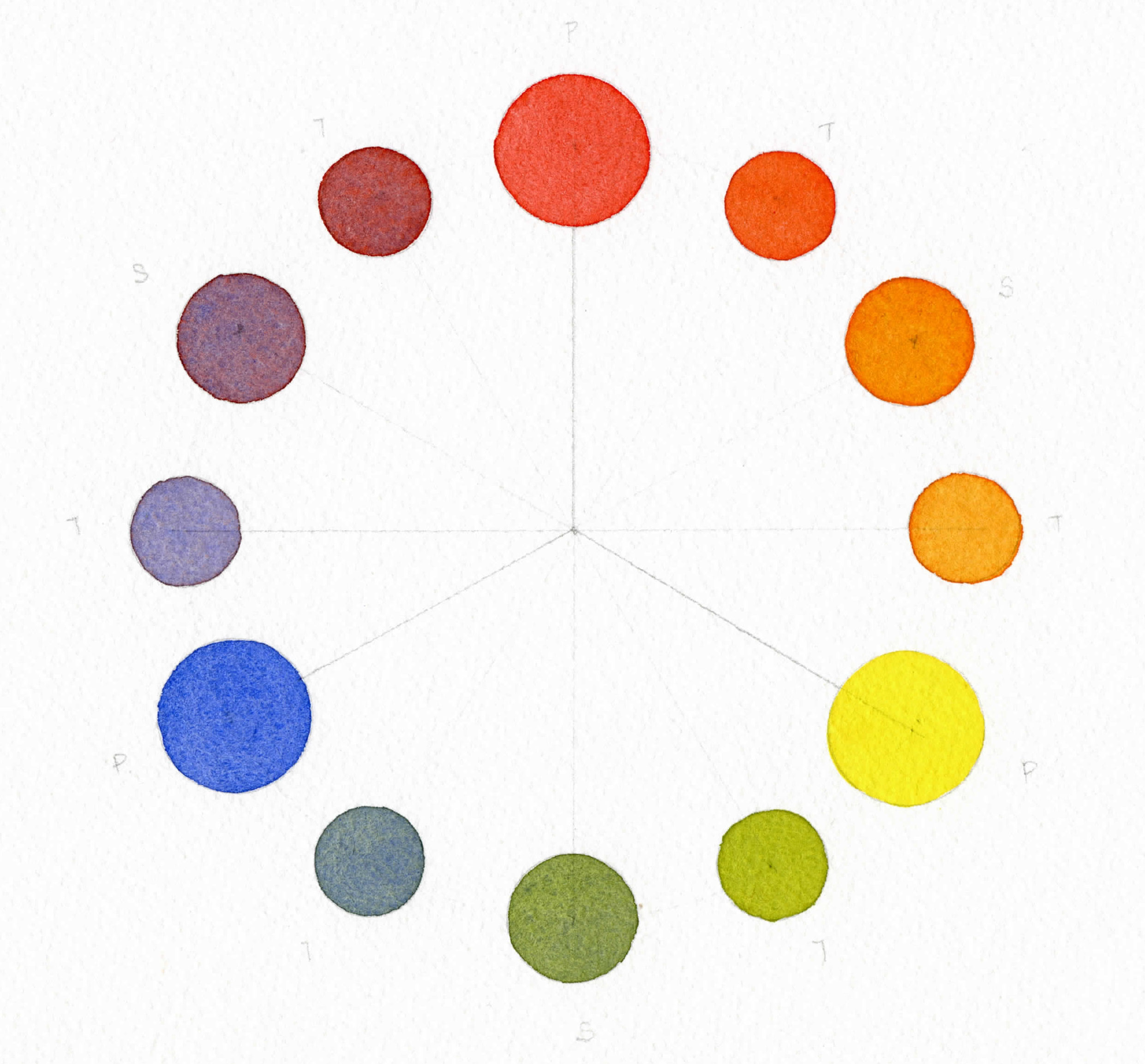
Warm Primaries
A option of primary colors that are warm-toned, meaning they have crimson/yellow undertones.
-
Pyrrol Scarlet
-
Hansa Yellowish Medium
-
French Ultramarine
(all Daniel Smith Watercolors )
Cool Primaries
A selection of master colors that are cool-toned, meaning they have more blueish/green undertones.

-
Quinacridone (Quin) Rose (yes, pinks can be used every bit reds!)
-
Hansa Yellow Light
-
Cerulean Blueish Chromium
(all Daniel Smith Watercolors )
It's really interesting how changing primaries creates such a different range of colors, isn't information technology?
Pupil Grade Paint Test
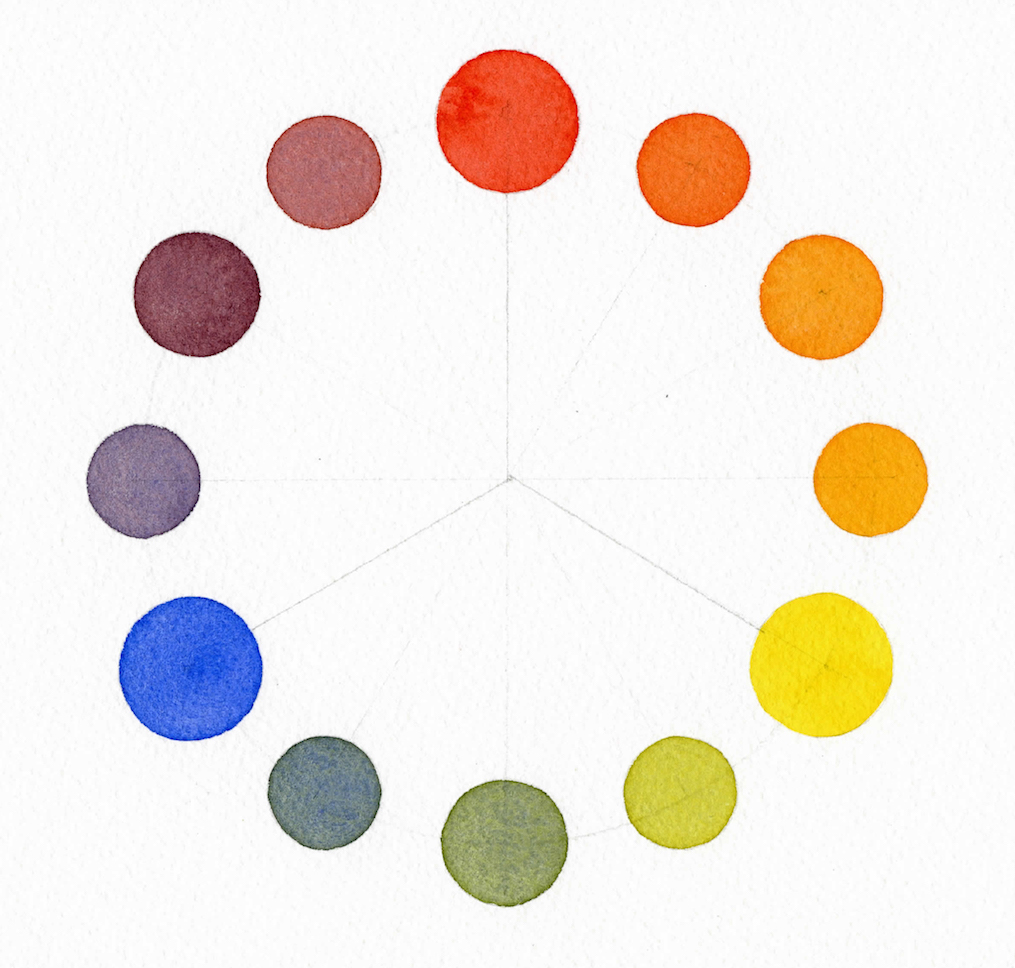
I similar recommending artist grade paints if it'south inside budget, just I did a test with my student class tube paints (what I started painting with) and I still got a cute color wheel out of it. Just annotation that when painting with student grade paints y'all'll need to "work" them more than (add more h2o and accept note to load your brush with more pigment). Because pupil grade paints accept more folder than paint, you'll demand to use more paint to get the aforementioned colour payoff, merely it can exist done!
Color Cycle using all Winsor & Newton Cotman (student form) Watercolors
-
Cadmium Red Hue
-
Cadmium Yellow Hue
-
Ultramarine
I hope you give this a endeavour and mayhap even experiment with variations of primaries if you happen to accept them in your paint collection.
Gratuitous BONUS: WARM + Cool COLOR WHEELS
I thought that having these color wheels might be useful as a reference (specially if y'all don't accept these colors but yet and are considering investing in them)! Click the link below and enter your email to get the free PDF:
Thank you for subscribing to my electronic mail listing!

If y'all're looking for a challenge, you might want to check out this color wheel by Jane Blundell that combines warm AND cool primaries into i wheel! Information technology looks fun and I accept information technology on my listing of things to endeavour out!
Adjacent week I'll mail watercolor chart type iv. If y'all've been following forth and found this helpful, let me know by liking this post or commenting below with whatsoever questions or suggestions for other things you'd like to see in the time to come!
Thanks for reading,
Susan

Source: https://susanchiang.com/blog/watercolor-charts-type-3-color-wheel
0 Response to "How to Draw a Color Wheel Circle"
Postar um comentário